The stories of the two women reveal horrific experiences of border violence, sexist violence and rape, racist exclusion and persecution, pushbacks to the desert and witnessing close people dying or being murdered. The perpetrators of abuse and violence are border guards and police forces as well as members of criminal networks profiteering from the vulnerable situation of people on the move.
At the same time, the stories of Jenneh Kargbo and Nanah Sesay also tell about the power and solidarity of women fighting to survive under most hostile conditions.
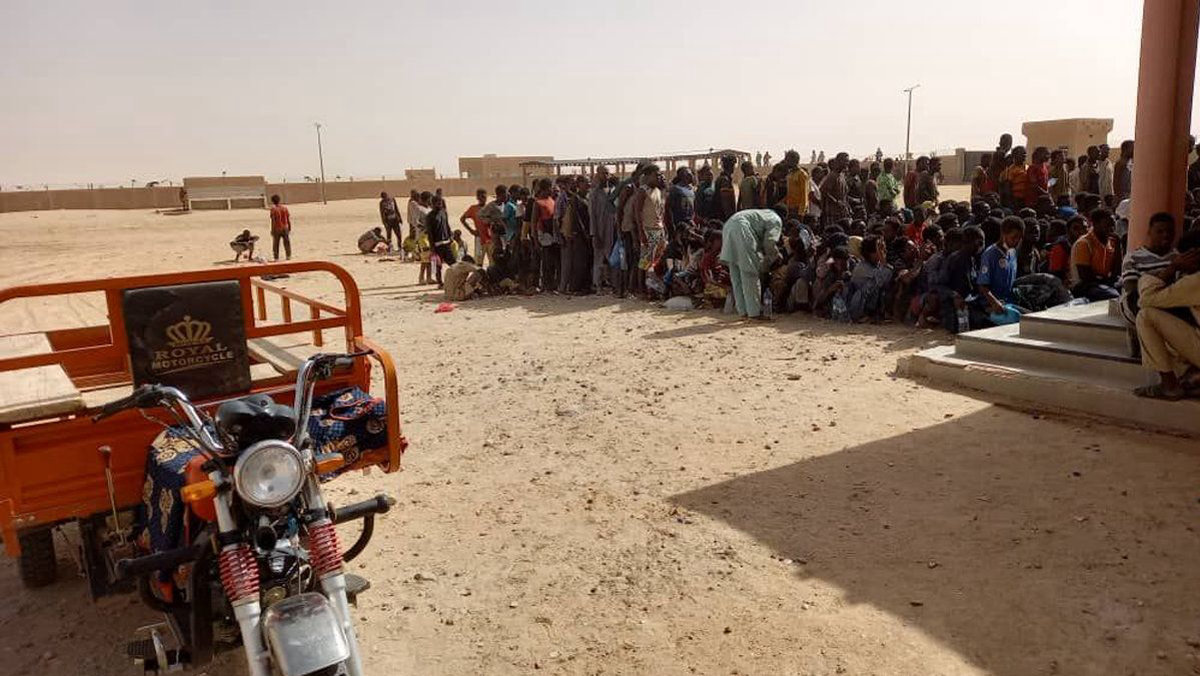
Both Jenneh Kargbo and Nanah Sesay were deported from Algeria to Assamaka on the border between Niger and Algeria in 2025. In Assamaka, they got support from the local Alarme Phone Sahara team. Both Jenneh Kargbo and Nanah Sesay are still on the move between Sahel and Maghreb countries and at the moment it is unknown how their lives continued.
Alarme Phone Sahara thanks Jenneh Kargbo and Nanah Sesay for sharing their stories and stands in solidarity with all women on the move, with all people on the move and for defending human rights and freedom of movement.
Interviews: Alarme Phone Sahara team Assamaka
Translation from Krio: Deborah Conteh
**********************************
Testimony Nanah Sesay -Part 1
My name is Nanah Sesay, and I am from Sierra Leone. While I was living in Sierra Leone, I stayed with friends, but life was very difficult. I had no idea what people meant by “Temple Run,” but some of my friends had already attempted that journey. Unfortunately, they were deported back to Sierra Leone. Those same friends later influenced me to take the journey myself because life was so hard. Even getting food was not easy, and I was struggling to take care of my daughter, whom I gave birth to as a result of rape.
Life in Sierra Leone was extremely tough, and because of the pressure and encouragement from my friends, I decided to take the risk. We first travelled by car from Sierra Leone to Guinea, and then from Guinea to Mali. From Mali, we went to a place called Tombouctou. There, they loaded us onto big trucks and took us through the desert, where we were abandoned.
The drivers—who were really mafias—separated the men and women. All the women were placed in one area, while the men were kept elsewhere. The mafias would strip the women naked, searching us for money, phones, or anything valuable. Anyone without valuables would be locked up in a house. I was locked up along with some of my friends.
One night, while the mafias were asleep, we managed to escape. Sadly, during our escape, I lost one of my friends. Later, I met some women in the desert who told me that I would not see my friend again. Others told me they don’t know where my friend is. This was so difficult for me, but I had no choice except to keep moving.
I worked for people just to survive and to feed myself and my child. After some time, I decided to continue the journey through the desert again. But since I had no money for transportation, I had to walk. The journey was extremely hard—we sometimes went days without food or water. I never imagined I would face such struggles, but somehow, I managed to reach Algeria.
In Algeria, life was not any easier. There were no job opportunities for women, and without documents, I couldn’t work or settle there. So, I decided to risk it again and cross into Tunisia with my child. Unfortunately, while running with my child, I was caught by the police. They returned us back to the desert, where I had to struggle to survive again.
Eventually, I managed to re-enter Tunisia. But life there was also very hard. When I tried to stop cars for help, no one would stop because they were afraid of police controls. I still hoped to cross the sea into Europe, believing that if I succeeded, I would finally be able to care for my daughter and my mother back in Sierra Leone.
With the help of some boys, I found my way to the place where boats depart for Europe. But the police would often raid that area, and police, as well as mafia, would scatter us. So, they raped me, they used me. They said they would leave me there. They shot around but gave me nothing. So, they took their advantage over me. One of the men left me with my daughter. So I was back to being alone. I went back to the desert.
I entered Tunisia and went to a place called Sfax.
In Sfax, I stayed in a hut, but the police constantly came to destroy our shelters. Many times, my child and I had no choice but to sleep on the streets on the bare ground. Life was very harsh, with little to eat, so I decided to go to a place called Homm, where I started begging for food. There, I met some kind people who helped me. So, life can be a easier for us small people inside Tunisia.
Testimony Nanah Sesay -Part 2
During my time in Tunisia with my child, life was somewhat more manageable. I met some kind people who helped us when we had no place to stay, and eventually, I was able to share accommodation with others. While this provided temporary relief, remaining in Tunisia was never my goal. My intention had always been to continue onward to Europe.
Through small jobs and occasional support, I managed to save some money. With these savings, I decided to return to Algeria in hopes of attempting the sea journey to Europe. Traveling from Tunisia posed greater risks, as those caught by the authorities were often either deported back to Libya or abandoned in the desert.
While returning from Algeria toward Tunisia, I encountered armed groups (mafias). Because I was traveling with my child, I was unable to escape. We were captured, and I was subjected to rape. At that time, I did not realize I had become pregnant as a result of the assault. I only discovered the pregnancy later, once I had managed to re-enter Tunisia, when I began experiencing physical symptoms.
Unfortunately, I had no support system, and the little money I had saved from begging in Algeria had already been given to an individual who had promised to assist me with the sea crossing. I remained in Algeria for two additional months and eventually reached the bay where departures toward Europe were organized. However, before we could depart, the authorities put me and my child in prison.
From prison, they sent me to Assamaka. From there, we were ultimately sent to Niger.
**********************************
Testimony Jenneh Kargbo
Assalamu Alaikum,
My name is Jenneh Kargbo, and I am here with my child, whose name is Hawanatu Turay. I met with a woman named Nanah Sesay while I was in prison in Algeria. I was imprisoned for several months because I was standing up for Sierra Leoneans living in Algeria. Later, Nanah Sesay was also sent to prison, and that is where I met her. She told me she is from Sierra Leone.
We stayed together until we travelled to Niger, to a place called Assamaka. She stayed by my side, encouraging me because I had lost my husband during the journey. While traveling, we were attacked by mafias who tried to rape us. My husband stood up to defend me and refused to let them take me, but because of that, he was shot and killed.
After that, life became very difficult. In Assamaka, I was homeless with my child, sleeping outside. Terrorists attacked us, and some of us were even hit by police cars. We had no proper place to sleep, no good water to drink, and no safety. I had to ask strangers for help just to survive with my child.
I have no mother and no father to turn to. I only wish for help so that I can return to Sierra Leone with my child. We are suffering and in great need of support.